Please See Below for Forwarding to FamilyReEntry.org and Prisonist.org. Thank You!

Showing posts with label Scott Semple. Show all posts

Monday, November 20, 2017

New Haven Independent: German Inspired Reform Calms Prison. CT Commissioner Scott Semple Appears on Criminal Justice Insider with Babz Rawls Ivy & Jeff Grant


Yale La


German-Inspired Reform Calms Prison


Young inmates are getting direction — not just detention — in one corner of Connecticut’s prison system, and they’re straightening out as a result.

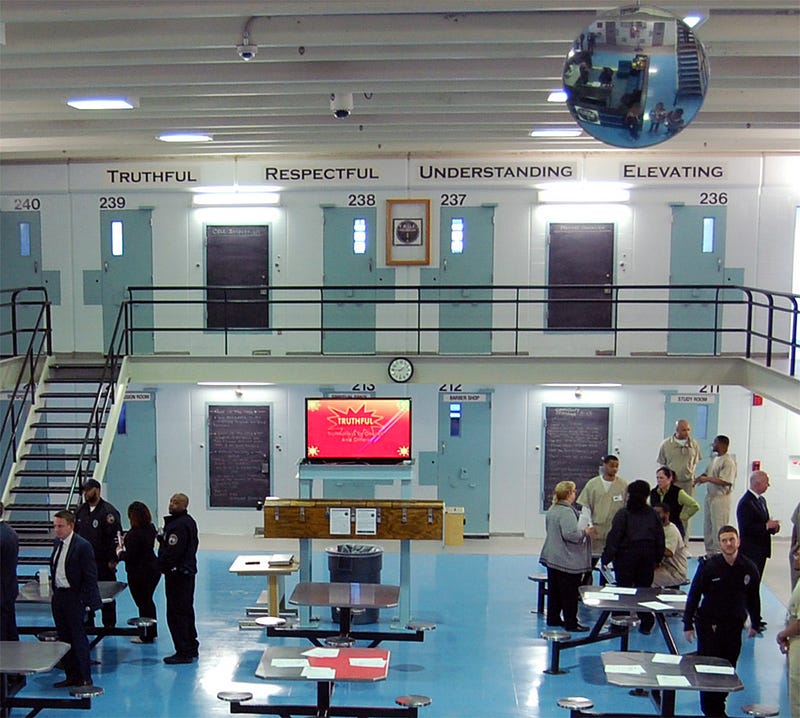
State Department of Correction Commissioner Scott Semple created the experiment called the TRUE program (which stands for Truthfulness, Respectfulness, Understanding and Elevating) — to help 18-to-25-year-old inmates mature into responsible adults behind bars, and prepare for successful and productive lives after they have been released from prison.

The program, inspired by a fact-finding visit Semple took to Germany with the governor in June 2015, is currently in place in one 70-bed unit at the Cheshire Correctional Institution. Because of its early success, Semple is looking to expand it to other units at Cheshire, as well as to the York Correctional Institution for Women.

Through the TRUE program, the young inmates are paired up with mentors who are older, fellow inmates serving life sentences for crimes that they committed while they were young.

Social workers from the Vera Institute of Criminal Justice lead roundtable conversations with the young inmates that encourage them to talk about how they are feeling, what they are hoping to accomplish through the program, and what their goals are for after they are released. The program applies “restorative” justice techniques that bring people who have been harmed and people causing harm together to resolve their conflict via face-to-face conversation as opposed to through further outbursts of violence.

Semple said that the program also rests upon active involvement of family members of the incarcerated, as well as open lines of communication and respect between the prison staff and the inmates.

Several months in, the program has been a success, Semple said on the latest episode of WNHH-FMs “Community Justice Insider with Babz Rawls-Ivy & Jeff Grant” program. “We’ve had little to no incidents in that unit [at the Cheshire Correctional Institution]. In essence, [this program has] created less trauma exposure and improved the health and wellness of the staff and the population.”
Semple noted that correctional officers often get a bad rap, and rarely get as many accolades as police officers, judges, or probation officers. Their work, especially in the context of the TRUE program, is critical for the successful rehabilitation of these young inmates, he said.

“Their job is extremely, extremely important in terms of the mission of improving public safety,” he said. “Because if they fail, the likelihood of failure from a public safety perspective is much more prominent.”

Nearly three years into his tenure as commissioner, Connecticut’s prison population is dropping precipitously, from a high of nearly 20,000 in 2008 to around 14,000 today. Two prisons have closed or contracted in this year alone, including Enfield’s medium security prison earlier this month.

And, with initiatives like the TRUE program at Cheshire set to expand, Semple said, he feels confident that the department he oversees is getting closer by the day to its mission of correction, not incapacitation.

“We are the model in the United States right now,” Semple said about Connecticut’s DOC. “We’re one of the few states in the country that has lowered its incarceration rate and its crime rate, and we’re beginning to see a reduction in recidivism.”

“It’s important that, whoever’s the next governor,” he continued, “they need to take a look at some of the practices that have been in place. And to realize the benefit in improving folks’ overall wellness.”
German Inspiration


Semple at WNHH FM with co-hosts Rawls-Ivy and Grant.
Invited by the Vera Institute of Criminal Justice in June 2015 to observe how other countries’ prison systems prepare inmates for re-entry into society, Department of Correction (DOC) chief Semple and Gov. Dannel P. Malloy found in Mecklenburg, Germany’s Neustrelitz Prison a facility that was specifically designed to meet the emotional and developmental needs of its 18 to 25-year-old incarcerated population.

Instead of throwing young people into lockdown or solitary confinement when they acted out, the German prison had programs that encouraged self-expression, communication between fellow inmates and staff, minimum-wage employment, and a certain degree of autonomy that tried to mimic what life was like outside of prison bars.

A self-proclaimed data-driven, incentive-based commissioner who is willing to experiment with different ways to reduce recidivism, Semple was deeply inspired by the respect, encouragement and sensitivity with which the German prison system treats its young inmates, he said.
“We’re not the department of incapacitation,” Semple said. “We’re the department of correction. And our job is to help correct people. We’re very good at dealing with problematic issues. Our facilities are clean and, for the most part, quiet. But how do we move beyond clean and quiet? It’s as simple as being responsive to people who want to be accountable to themselves.”

After returning from Germany, Semple crunched the numbers on his own prison system. He found that 3,000 people, or roughly 20 percent of the state’s incarcerated population, fell between the ages of 18 and 25. Those younger inmates accounted for roughly 25 percent of all disciplinary incidents within the state’s prison system.

“We do know that this is a very impulsive age,” Semple said. He admitted that, when he was a teenager growing up in Waterbury in the 1970s, he was involved in activity that very well might have gotten him arrested if he were in high school today.

He talked to the governor, reached out to the Vera Institute, and decided to bring a little bit of the German incarceral approach to the Nutmeg State.
Inspired By Personal Tragedy
Semple started out as a correctional officer at the Cheshire Correctional Institution back in 1988. Over the years he has served as legislative liaison for the DOC, warden for the Garner Correctional Institution, deputy commissioner of operations for the DOC, and, as of 2015, DOC commissioner.
Shortly after Semple became deputy commissioner, his son Matthew was diagnosed with a rare form of cancer. Soon after he became commissioner, his son passed away.

Semple spoke about how he and his wife struggled to decide whether or not he should accept Gov. Malloy’s offer to serve as commissioner when going through such a difficult time in their lives. Ultimately, he decided to do it, heeding his late son’s strong encouragement to take the position.

“The things you traditionally get worked up about did not seem to bother me as much because quite frankly the worst thing in my life has already happened,” Semple said about how his son’s life and premature death have inspired his passion and willingness to experiment as the head of the DOC. “So why not be bold? It really led and energized the direction that I felt compelled to take this department to.”

“Criminal Justice Insider” airs every first and third Friday of the month on WNHH FM at 10 a.m. Listen to the full interview with Scott Semple here or Facebook Live video here.


“Criminal Justice Insider” is sponsored by Family ReEntry and The Community Foundation for Greater New Haven.

Thursday, October 19, 2017

Press Release: New Radio Show Explores Criminal Justice from the Inside — and Out: Babz Rawls Ivy & Jeff Grant Launch "Criminal Justice Insider"on WNHH New Haven


Press Release: New Radio Show Explores Criminal Justice from the Inside — and Out 

 Babz Rawls Ivy & Jeff Grant Launch "Criminal Justice Insider"on WNHH New Haven

New Radio Show: Criminal Justice Insider 

Bridgeport, Connecticut   October 19, 2017   Business News
(PRLEAP.COM) The airwaves are open to discuss Criminal Justice - from the Inside. A new show, Criminal Justice Insider, co-hosted by WNHH-FM's Babz Rawls-Ivy and Family ReEntry's Executive Director, Jeff Grant, takes a unique perspective on all issues of the justice system, including the effects of incarceration and the challenges faced by ex-offenders.

A major intrigue of the program can be found in the

personal background stories of the show's co-hosts. Rawls-Ivy and Grant have both served prison sentences. As ex-offenders, they are well aware of the challenges, inside and outside, of the legal system and the prison system. They are also both examples of success and hope for others.

The show, which debuted last Friday, welcomed a much larger than expected audience, and WNHH immediately doubled its originally scheduled programming. Criminal Justice Insider is now slated for a full hour at 9:00AM on the first and third Fridays of each month.

Rawls-Ivy, who is also the host of WNHH's daily "LoveBabz LoveTalk," and editor of the Inner City News, proclaimed, "Jeff and I have talked about doing something like this for a while. When we pitched the topic to the station, we presented so many aspects that affect so many people, not just in Connecticut but all over the country, the content designed itself."

As the executive director of Family ReEntry, a social service organization in Bridgeport that works with individuals and their families who have been directly impacted by incarceration, Grant is a perfect complement to the show. "This show is important because we go deep into the personal challenges and successes that individuals, families and whole communities experience. There are not many places that welcome and encourage the authentic, vulnerable side of the criminal justice experience."

The next broadcast of Criminal Justice Insider will be on Friday, November 3rd with special guest, Connecticut State Representative from New Haven, Robyn Porter. Upcoming live shows will feature lively discussions from a series of different guests, such as Connecticut Department of Correction Commissioner Scott Semple, Katal Center Co-Executive Director Lorenzo Jones, Carlah Esdaile-Bragg of Cornell Hill Scott Health and Marcus Bullock of Flikshop, along with many others.

Working in affiliation with local news source, The New Haven Independent, a recap of each Criminal Justice Insider show and a preview of upcoming shows will be published. For anyone who hasn't already heard the program, the debut broadcast is now available in its entirety on SoundCloud and to keep up with the topics of discussion, a Facebook page has also been set up at Criminal Justice Insider.

More about Family ReEntry: Family ReEntry is a 501c3 nonprofit, which was founded in 1984 as a reentry support group for men at the Isaiah House in Bridgeport. It has since grown to include policy advocacy, and intervention, prevention, in-prison, reentry, fatherhood and youth & family programs. Over the past 33 years, effective advocacy efforts and community-based programs developed by Family ReEntry have significantly reduced the likelihood that clients will re-offend, be re-arrested, or be re-incarcerated. Its programs provide a spectrum of services designed to disrupt the intergenerational cycle of incarceration. Family ReEntry addresses the specific needs of each client and their families through individualized case management and support services. It works to create a positive social network for each client, helping make their transition from prison back into the community a successful, self-sufficient one, while strengthening their families and the community. Family ReEntry operates its programs in strategic locations that encompass eight municipal regions and judicial geographic areas, two parole districts and five prisons. Approximately, sixty-percent of those served by Family ReEntry are from greater Bridgeport – Connecticut's largest city. The organization has offices in Bridgeport, Norwalk and New Haven, CT. Programs are also held in Stamford, Waterbury, Derby, New London and Norwich, CT. More information is available at www.familyreentry.org and on its social media including, Facebook, Twitter, Pinterest, Instagram and YouTube.


Contact Information
Greg Walsh
Family ReEntry
203-292-6280
Contact Us

Thursday, June 1, 2017

Correcting Corrections in Connecticut: How Commissioner Scott Semple Is Making Juvenile Justice More Just


Prisonist.org: Faith & Dignity 
for the Days Ahead
Blogs, Guest Blogs & News 

Over a Quarter-Million Views and Growing!

Correcting Corrections in Connecticut: How Commissioner Scott Semple Is Making Juvenile Justice More Just


Reprinted from Public Safety on Medium.com, By Steve Hawkins

This is part of a series of interviews conducted by Steve Hawkins, president of the Coalition for Public Safety, featuring individuals taking the initiative to change the justice system within their sphere of influence.

How deeply should brain science inform our approach to crime? In many justice reform circles, that’s up for debate. Research showing that human brains do not fully develop until the age of 25 has led many correctional leaders to reconsider the age at which young people “age out” of the juvenile justice system. If younger minds are more amendable to treatment and rehabilitation, the logic goes, why not take the opportunity to get things right?

Enter Scott Semple, commissioner of the Connecticut Department of Corrections. Connecticut’s journey to justice reform has already produced a notable decrease in both the crime rate and prison population, freeing up space and resources for Semple and others to more expansively rethink how to effectively administer justice. Semple has taken that opportunity to hone in on youth incarceration and recidivism with the creation of the T.R.U.E. Unit — a program for incarcerated young adults within the Cheshire Correctional Institution, designed specifically for 18–15 year olds. Young adults incarcerated at Cheshire are taught both practical and relational skills with the goal of helping them avoid the cycle of recidivism and emerge capable, compassionate adults.

I had the opportunity to connect with Commissioner Semple about his vision for the program at length. The interview has been edited for clarity.

S.H.: What was the source of inspiration for your new second chances initiative at the Cheshire Correctional Institution, and why are you launching it now?

S.S.: In 2015, I had the pleasure of visiting prisons in Germany with Connecticut’s governor, Dannel P. Malloy, and members of the Vera Institute of Justice. Among the many remarkable things I witnessed was a prison facility, which housed only young adult offenders. The operation of the facility was geared to the specific needs of that age group.

The goal was to launch a similar facility within the Connecticut Department of Correction. Initially, we had hoped to dedicate an entire facility to the needs of young adult offenders, but due to fact that this was a groundbreaking concept, coupled with a difficult fiscal climate, the decision was made to start out by opening a single unit within a facility. After much planning and hard work, the unit officially went online in March 13 of 2017.

S.H.: What is the history of Cheshire, CT, and why was this the place you launched T.R.U.E.?

S.S.: The building that comprises the original portion of the Cheshire Correctional Institution predates the inception of the Department of Correction as a state agency by more than 60 years.

Established by the Connecticut General Assembly in 1909 and opened in 1913 after three years of construction, the facility was first known as the Cheshire Reformatory. Ironically, it was designed as a reformatory for male offenders ages 16 to 24, with the intention of separating these offenders from the adult prison population. Within the context of the Department of Correction, the Cheshire Correctional Institution houses primarily long-term sentenced adult offenders.

The reason this facility was chosen as the site for the T.R.U.E. Unit is, quite simply, its staff. Warden Scott Erfe, the management, as well as the rank and file of the facility all embraced the challenge of implementing this new concept. In fact, more than 100 staff members volunteered to work in the new unit.

S.H.: This program focuses specifically on 18-to-25-year-olds. What is unique about this age group, and why is the state investing in changing their outcomes in the justice system?

S.S.: Scientific research has shown that the brain is not fully developed until around the age of 25. Neuroscience has shown that a young person’s cognitive development continues into their early twenties, and that their emotional maturity, self-image and judgment will be affected until the prefrontal cortex of the brain has fully developed.

Offenders in this age group frequently display poor decision-making ability, and are also prone to impulsive behavior. These factors, when combined, all too frequently result in disruptive behaviors which endanger not only themselves and other offenders, but staff as well. It is in everyone’s best interest to attempt to better manage this age group with the hopes of reducing the number of violent incidents within our facilities.
S.H.: The program is titled: T.R.U.E., which stands for Truthfulness, Respectfulness, Understanding, and Elevating. What is the importance of each of the elements?

S.S.: Ironically, the actions defined in the acronym of the T.R.U.E. Unit, are actions that offenders, especially in this age group, struggle with. They struggle with being truthful, with being respectful, with understanding another person’s[perspective]. The acronym T.R.U.E. serves as a constant mental, as well as visual, reminder of what they are striving for, what they aspire to be.

S.H.: Describe how the program works.

S.S.: The program works on a therapeutic community based model that applies behavioral modification techniques in association with peer mentoring guidance from offenders who are serving life sentences. Family support is also a key component of the unit.

S.H.: How does T.R.U.E. differ from previous approaches in Connecticut, and why do you think it will work?

S.S.: We have never before targeted the specific age group of 18-to-25-year-olds. Up until now, the demarcation between an adolescent and an adult was 18. If an offender was 18 years old, they were not only considered adults, but they were also treated like adults. We now know, thanks to scientific research, that this may not be the best approach.
To be candid, because this is the first of its kind unit we are facing many unknowns. However, early anecdotal reports indicate that the changes are working. As time goes by, we will collect data on such factors as disciplinary reports in order to create tangible performance measurements for the unit.

I also firmly believe that, thanks to the high caliber of the staff members working within the unit, the T.R.U.E. Unit will be successful.

S.H.: What role does family play in the rehabilitation of people behind bars?

S.S.: Simply put, family support plays an essential role in the rehabilitation of offenders. If offenders have strong family support, their chances for successful reintegration are greatly enhanced. That is why staff at the T.R.U.E. Unit have made additional efforts to engage and connect with the family members of offenders.

They have gone out of their way to invite family members of the incarcerated to informational session at Cheshire. The staff has also taken the added measure of creating a special email address for family members of those in the unit. The email address allows for specific information related to be shared quickly and frequently, thus keeping family members and offenders invested in the success of the unit.

S.H.: The T.R.U.E. mentors are serving life sentences. How does this program challenge some of our assumptions about people sentenced to life in prison?

S.S.: It is often assumed that those serving life sentences have no incentive or motivation to act in a constructive manner. After all, no matter what a “lifer” does, he’s never getting out.

The reality is that many lifers feel the need to find some meaning or value in their lives. They often informally offer advice to younger offenders, hoping to help them avoid the mistakes they had made.

The use of lifers in the T.R.U.E. program is a win/win/win situation. The young offenders, or mentees, benefit from the wisdom of the mentors. The lifers are able to feel that they are being productive by giving something back. Even the staff wins, as the mentor/mentee relationships improves the overall climate in the unit.

S.H.: Was it counterintuitive to imagine people who have committed serious crimes helping younger men chart a new course for their lives?

S.S.: For someone not familiar with a correctional environment, the idea of a lifer helping anyone is indeed counterintuitive. But for those who work inside prisons, older offenders giving advice to younger offenders is a daily occurrence.

S.H.: It’s not always immediately intuitive to people that an investment in changing correctional practices can be an investment in public safety. How do you see this as ultimately upholding the safety of all of Connecticut’s diverse communities?

S.S.: A frequently quoted statistic is that 95 percent of all offenders will eventually return to the community. Would you rather have offenders return to their communities and just pick up where they left off with antisocial and violent behaviors? Or would you rather have them equipped with the support and knowledge necessary to enable them to return as productive, law abiding members of society?

S.H.: How have correctional officers responded to and engaged in the T.R.U.E. program?

S.S.: The officers’ reaction to working in the unit has been extremely positive. Who wouldn’t want to feel like their efforts are having a positive impact on the lives of others?

S.H.: Do you have any favorite stories from the program to date?

S.S.: The vast majority of the staff members working in the T.R.U.E. Unit are seasoned correctional veterans with many years of experience. Traditionally, these staff members have always thought of offenders as inmates — undistinguishable, interchangeable, and incorrigible. While speaking with someone working in the T.R.U.E. Unit, they referred to the offenders in the unit as mentors and mentees. Having an appreciation of correctional culture as I do, this seemingly simple change in terminology in fact represents a significant change in the way we do business.

S.H.: How do you plan to measure success of the T.R.U.E. program? Does the Connecticut DOC track recidivism rates in all of its facilities?

S.S.: We are collecting data specific to the T.R.U.E. Unit on such things as disciplinary infractions. It will take some time, but we will also compile recidivism statistics specific to the unit as well.

S.H.: Do you have plans to expand this program or bring similar versions to other Connecticut facilities?

S.S.: Plans are already in the works to open a similar unit at the department’s only female facility, the York Correctional Institution. If all goes as planned, the unit should be up and running within the next six months.

S.H.: What would you like your legacy to be when it comes to justice reform in Connecticut?

S.S.: I am no different than anyone else. Just like the staff of the T.R.U.E. Unit, I am trying to implement policies that will have a lasting positive effect on the lives of offenders.

Sunday, November 15, 2015

Connecticut Gets & Gives A #SecondChance, By Andy Thibault - Guest Blogger

Prisonist.org: Blogs, Guest Blogs 

& News Concerning National and

International Criminal Justice Themes


Connecticut Gets & Gives 
A #SecondChance

By Andy Thibault - Guest Blogger

How Much Has Connecticut Progressed 
Since Prisoners Were Punished 
For Therapeutic Writing?


Our post Ready For Freedom (Oct.29th) 
announced a panel of Connecticut criminal justice 
experts that will be speaking at the Hartford Library 
on Weds., Nov. 18, 2015.  The panel's moderator, 
 Andy Thibault, guest blogs below for prisonist.org
__________

HARTFORD – Connecticut has progressed in some measure since prisoners were punished by the full weight of state government for therapeutic writing about a dozen years ago.

How much?

We’ll get some solid answers from a spectrum of well-informed sources – including prison authors and top state officials – during a #SecondChance forum Wednesday at 6 p.m. the Hartford Public Library. The official program title is: “Ready for Freedom? Life after Prison in Connecticut.”

Panel participants will include Scott Semple, Commissioner of the Connecticut Department of Correction, Deborah Rogala, Program Operations Director at Community Partners in Action, Robert J. Devlin, Jr., Chief Connecticut Criminal Court Judge, and Bonnie Jean Foreshaw, incarcerated for 27 ½ years and granted clemency in 2013 after appeals and a review of her case. Also participating: Gary Roberge, Director of Adult Probation and Bail Services, State of Connecticut, the Rev. Jeff Grant, Director of the Progressive Prison Project, and Robin Cullen, of Color Outside the Lines, an organization that facilitates groups in prisons and community outreach programs.

Foreshaw and Cullen both contributed to the critically-acclaimed book, “Couldn’t Keep It To Myself – Testimonies From Our Imprisoned Sisters,” edited by the novelist and jailhouse teacher Wally Lamb and published by Harper Collins with Judith Regan.


 (Photos: Bonnie Foreshaw & Robin Cullen)
“Couldn’t Keep It To Myself” grew out of the despair that engulfed the Niantic jail in 1999. Two suicides and a number of suicide attempts led staff members including librarian Marge Cohen and teacher Dale Griffith to canvass peers and inmates about what might help. Dancers, musicians and businesswomen came to the jail to volunteer. There was also talk that writing might help as a coping tool.

Cohen reached out to Lamb, who at that time was studying how to say no. Lamb said yes, he would do a workshop.

“You coming back?” he was asked as the 90-minute session ended. “Uh, well OK,” he said. “Write something and I’ll see you in two weeks. Any subject, two pages minimum.”

Thirty students dwindled to 15. One woman sat hunched forward, fists clenched on her desktop, silent, for 90 minutes. In the third session she raised her hand. She read a story of her life, in two pages. Like many of the tales of her peers, it included incest, abuse, depression, indifference. Lamb said the writer, Diane Bartholomew, “sledge-hammered the dam of distrust, and the women’s writing began to flow.”

Three workshops turned into 50 and they stopped counting [more than 12 years ago]. The writing got better and better. Lamb taught the students how to recast memories as dramatic scenes. Then he read a piece to powerhouse publisher Judith Regan, who wiped her eyes and said, “Shall we do a book?”

The inmates did what they were supposed to do: They confronted themselves and developed the will to strive for better lives. They offered a message of redemption and hope.

“He [Lamb] helped the women to be more realistic,” Foreshaw said recently, “instead of taking that way [suicide] out.”

The state played dumb during the Rowland administration, ignoring Lamb’s requests for feedback on this success story. Then, Connecticut’s state government attacked with a vengeance.

Then- state Attorney General Richard Blumenthal filed suit, placing liens against their virtually non-existent assets ranging up to $913,777 for Foreshaw. Cullen, who had served her time and would go on to work for Mothers Against Drunk Driving, was confronted at home by a deputy sheriff.

“My first reaction when I see this guy with a badge is somebody’s coming to take me back to jail,” Cullen told CBS’s 60 Minutes. “My bill, was, I believe, $139,000.”

The state of Connecticut was just warming up.

The Correction Department spokesman denied that the work of the writers was destroyed, removed or taken away. In fact, hard drives, diskettes and personal papers were all taken away from members of the writing group. This was the department’s response to the literary group PEN awarding writing group member Barbara Parsons a $25,000 prize in absentia for fighting to safeguard the right of free expression. The award was sponsored by A.E. Hotchner and Paul Newman.  

“Effective immediately, all activities related to the Wally Lamb writing group are suspended,” Dorothula Green, principal, wrote in a memo. “Students involved in this program will not engage in any activities related to this program. Computers, other equipment, time, space in classrooms are not to be used.”

The memo – one of two written by Green – came days after The Norwich Bulletin reported that Lane had won the prestigious PEN award for freedom of speech.

Green, in cooperation with the warden at the time and other higher-ups, went out of her way to give the writers the message: “The Thursday Writing class is being reviewed. Therefore, it is suspended. Students involved in this class will not engage in any activities related to this program. All computer disks, as are, are to be returned in to my office immediately and all information on hard drives is to be removed. Computers, other equipment, time and space, are not to be used for purposes related to the Thursday Writing Class.”

Blumenthal ultimately withdrew the lawsuit – citing the rehabilitative nature of the book – and as a U.S. Senator he later supported Foreshaw in her clemency bid. He negotiated a royalties settlement with the prison writers that funneled a total of $4,000 to the re-instated writing program and the state Department of Mental Health and Addiction Services.

I got into this story reading “Couldn’t Keep It To Myself” and attending the writing workshop at the Niantic jail. Over more than a decade, I researched and wrote extensively about police, prosecutorial and judicial misconduct in the Foreshaw case. The turning point came after publishing the long-suppressed memo Judge Jon Blue wrote as a public defender: Blue detailed the jacked-up charge of premeditated murder of a person Foreshaw had never met in an accidental shooting and the myriad failures of her unseasoned lawyer to provide an adequate defense.

In the intervening years I got to know Parsons, Cullen and Foreshaw as fellow writers, gaining a respect for their journeys of survival.

Foreshaw has spoken eloquently about her remorse, prison experience and challenges on the outside during appearances at Gateway Community College in New Haven and the Oliver Wolcott Library in Litchfield. You can be sure she won’t hold anything back during the Nov. 18 forum.

Nor will the other participants.

Scott Semple, the new Correction Comissioner, is a strong advocate for Gov. Dannel Malloy’s Second Chance Society – which was the result of bipartisan support. Semple has presided over a reduction of about 4,000 inmates in Connecticut’s prison system, down from a high of about 20,000.

The Second Chance Society law promises to “ensure nonviolent offenders are successfully reintegrated into society.”

“I am open to any questions and looking forward to a learning experience,” Semple said in advance of the forum.

Another participant, Gary Roberge – Director of Adult Probation and Bail Services – is prepared to address questions including how the state can help with jobs and housing.

As Connecticut’s criminal court administrator, Judge Robert Devlin can speak to his experience working with probation to help ex-offenders resolve technical violations.

The 90-minute forum will begin with statements from the participants and will include questions from the audience.

Big thanks to Jeffrey Mainville of the Hartford Public Library for putting this program together and for asking me to be the moderator. We have a talented and diverse crew for this event, all working in earnest to improve the quality of life in Connecticut.

LINKS:

Official announcement via Hartford Public Library is posted here: http://cooljustice.blogspot.com/2015/11/hplct-announces-ready-for-freedom-nov.html

Photos, bios, background: http://cooljustice.blogspot.com/2015/10/all-star-lineup-for-upcoming.html

Foreshaw & Thibault podcast, Oliver Wolcott Library:
http://cooljustice.blogspot.com/2015/10/morecooljustice-foreshaw-thibault.html\

The Blue memo:
http://www.scribd.com/doc/147874099/The-Blue-Note


[Editor’s Note: Posting & reprinting this column OK courtesy of the Progressive Prison Project/Innocent Spouse & Children Project]
__________

Andy Thibault, author of  "more COOL JUSTICE’ , covered the Boston Marathon bombing trial for NBC News and WhoWhatWhy.com.  Thibault was honored in 2014 by the Connecticut Council on Freedom of Information with the Stephen Collins Award for his “many contributions to the cause of open and accountable government and a free and vigorous press.” Currently, he works as a private investigator for Integrated Security Services of Hartford. Andy's Twitter handle is @cooljustice. He can be reached at tntcomm82@cs.com.
__________
Progressive Prison Project/
Innocent Spouse & Children Project

Rev. Jeff Grant, JD, M Div, Minister/Director
jgrant@prisonist.org

(o) 203-769-1096

(m) 203-339-5887


Lynn Springer, Founding Advocate, Innocent Spouse & Children Project
lspringer@prisonist.org

(203) 536-5508

George Bresnan, Advocate, Ex-Pats
gbresnan@prisonist.org
(203) 609-5088

Jim Gabal, Development
jgabal@prisonist.org
(203) 858-2865

Babz Rawls Ivy, Media Contact
mediababz@gmail.com
(203) 645-9278   


DONATIONS

 https://www.paypal.com/cgi-bin/webscr?cmd=_s-xclick&hosted_button_id=R6XKLHXQJ6YJY
 
We are grateful for donations from individuals, religious groups, charities, foundations and the like. Donations can be made by credit card/PayPal or by sending your check payable to: “Progressive Prison Ministries, Inc.” P.O. Box 1232, Weston, Connecticut 06883. Progressive Prison Project/Innocent Spouse & Children Project are missions of Progressive Prison Ministries, Inc. We are a CT Religious Corp. with 501c3 status - all donations are tax deductible to the extent permitted by law. Thank you for your support and generosity.


If transformation and redemption matter to you, a friend or a family member with a white-collar or nonviolent incarceration issue, please contact us and we will promptly send you an information package by mail, email or via Dropbox. The darkest days of a person's life can be a time of renewal and hope.